Open-source discovery
Collect candidate images using person name, birth date, role, aliases, and public credits from configurable sources.
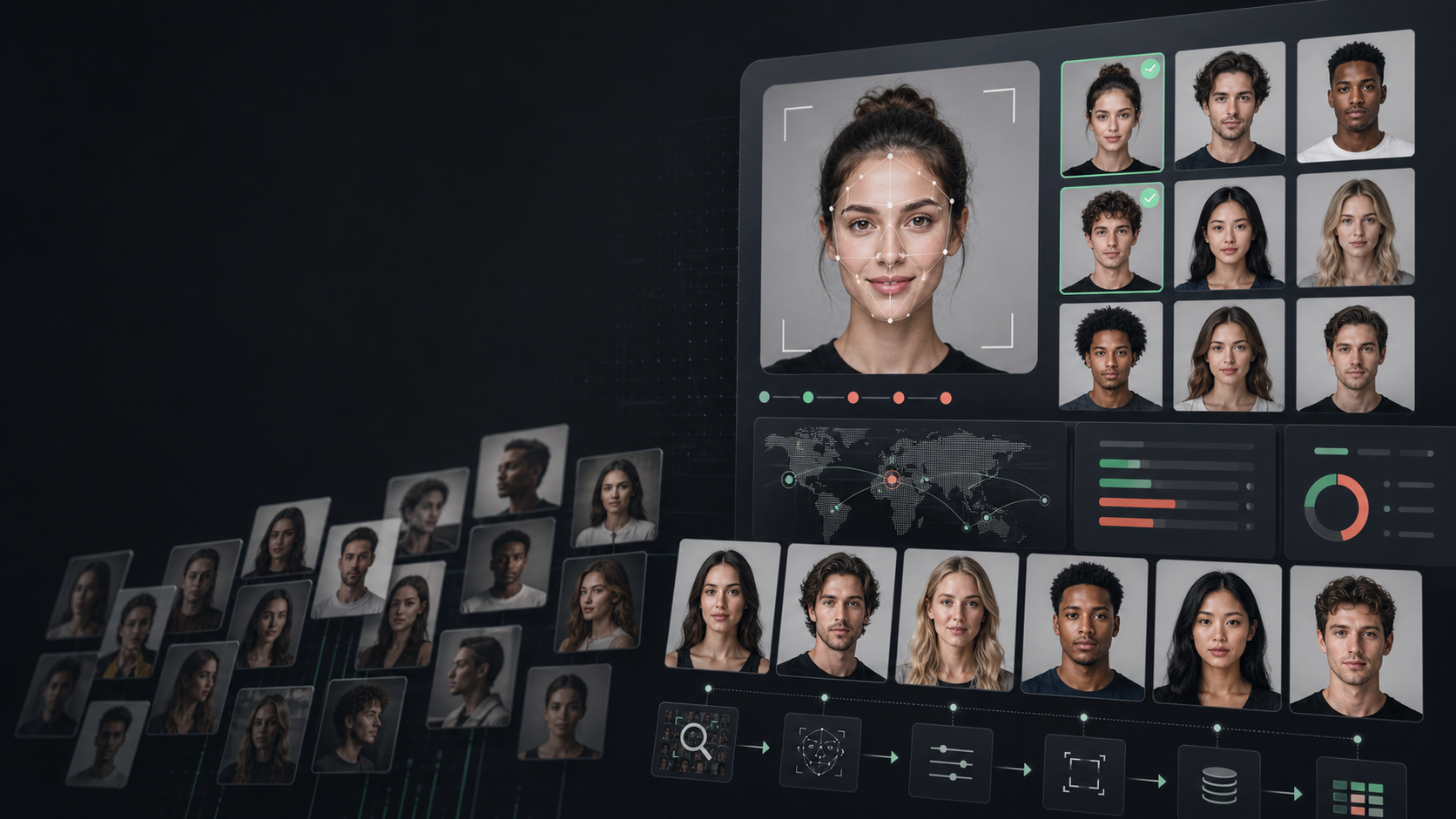
Computer vision, web search automation, and production QA
An identity-first pipeline for actor and public-figure profile cards: find candidates in open web sources, prove the image belongs to the right person, transform it into a strict portrait format, and ship every decision with a reviewable audit trail.
What the system does
CastFaces is built for media catalogs, streaming content operations, talent databases, editorial archives, and public-figure directories where the hard part is not only finding a face. The system must prove whose face it is, decide whether the source is usable, and produce a portrait that matches a strict publishing format.
The architecture is modular: source discovery, proxy-aware collection, image processing, quality audits, retry logic, and operator review can run together or as independent services.
Collect candidate images using person name, birth date, role, aliases, and public credits from configurable sources.
Rank candidates with Identity Match, source authority, contextual evidence, disambiguation checks, and reject reasons.
Create consistent 400x400 PNGs with face size control, eye-line alignment, centered framing, and clean background.
Generate Portrait Quality and Frame QA reports, debug overlays, retry history, and delivery summaries for review.
Identity verification
The project is designed around actor and public-figure cards, where false identity is worse than a weak image. Search results are treated as candidates, not truth. Each candidate is checked against the source page, surrounding text, role, dates, aliases, credits, source authority, and position in the result set.
Name, role, birth year, aliases, and known public credits
Authoritative profile, exact name, matching role and credits
Press result, partial context, visually usable but needs review
Generic page, weak context, possible name collision
Names, aliases, dates, roles, and known credits sharpen searches and reduce false positives.
Official pages, professional databases, encyclopedic sources, and generic pages receive different trust weights.
Same-name people are filtered by birth year, profession, public credits, source snippets, and conflicting context.
Candidates pass, weaken, or reject with readable evidence, so operators know why a photo was selected or blocked.
Scene-to-card transformation
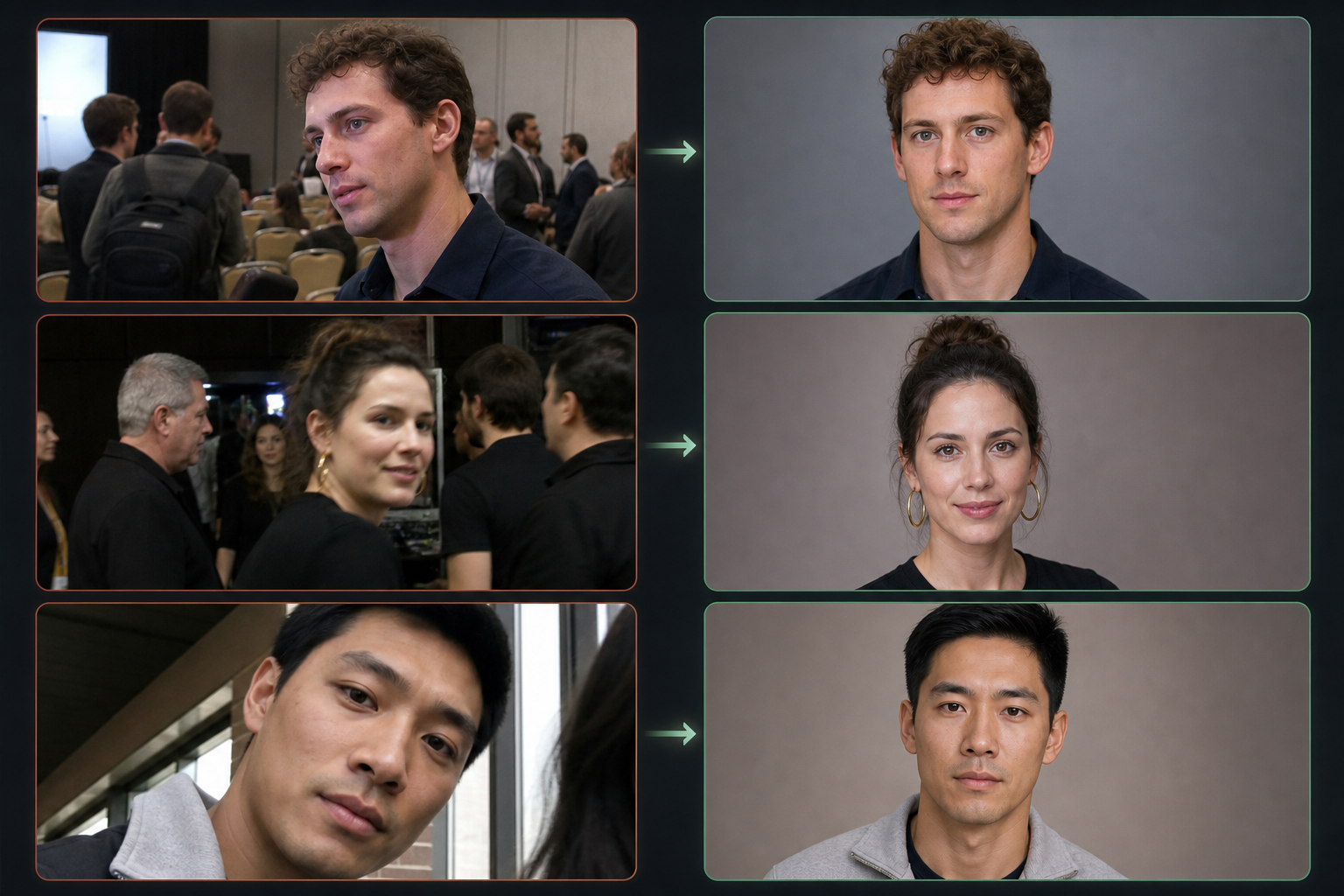
Source images are rarely studio headshots. They can be conference photos, backstage images, screenshots, press stills, or phone-like crops. The engine detects the face, estimates geometry, evaluates whether the image is usable, removes distracting background, aligns the eyes, controls face size, and validates the result against the output spec.
Real DEV debug: standard overlay plus projected person mask, eye shapes, mouth shape, and source-edge markers.
Real DEV overlay shows the same landmarks and crop gates used to block visible source-cut risk.
Frame QA verifies the square crop; mask and feature overlays expose eyes, mouth, face contour, and transition risk.
Visual examples on this prototype use synthetic, non-celebrity portraits generated for demonstration.
DEV engine assessment
The numbers below come from CastFaces DEV runs on July 4, 2026 using the synthetic source and result files shown on this page. Final portraits are processed through the engine, rendered with real debug overlays, and scored against the same visible-cut, geometry, background, and format gates used by the delivery workflow.
Local DEV engine, synthetic demo assets, public-safe labels.
Two final portraits pass; one is blocked for visible source-crop risk.
Blur and off-angle evidence are preserved before transformation.
Image, real debug overlay, source reference, and validation data.
Blurry; bad angle, yaw -31 deg, sharpness 42.
Face 75.0%, yaw -10 deg, eyes 0.335, sharpness 161.
Blurry source, sharpness 15, yaw 25 deg.
Blocked: visible top source crop. Face 75.5%, yaw 3 deg, sharpness 240.
Blurry source, sharpness 22, tight crop risk.
Face 76.0%, yaw 1 deg, eyes 0.309, sharpness 208.
Output requirements
The goal is not a pretty thumbnail by chance. The output must match a repeatable profile-card contract: fixed size, face proportion, eye-line, centering, clean background, no text or logos, and a traceable validation report.
Quality control
CastFaces separates identity confidence from visual quality. Identity Match decides whether the image likely belongs to the right person. Portrait Quality and Frame QA decide whether the processed result is usable as a circular or square asset.
The real DEV overlay and validation report flag visible top source crop. The operator can rerun search, adjust processing parameters, or reject the candidate before delivery.
Workflow
The same project can be used through an operator UI, direct REST API calls, or a mixed review-and-automation mode.
CSV, JSONL, JSON, or TXT with profile IDs, names, dates, roles, and optional public credits.
/fetch_photos collects images, URLs, snippets, dimensions, and source errors.
Identity Match applies source authority, name/date/context matching, caps, and rank adjustment.
/process_photo returns result PNGs, debug overlays, metadata, and validation.
/smart_fix/recommend suggests safe next parameters for geometry, background, and detail issues.
Bundles include final images, source references, reports, JSON traces, and summary CSV files.
Operator experience
Operators can monitor search progress, inspect candidates, launch full-auto processing, switch to manual controls, and export a delivery bundle with every decision preserved.
Image rights and compliance
This website prototype uses synthetic demonstration portraits. They are not real public figures, clients, or production search results.
CastFaces does not grant ownership, copyright, publicity, privacy, or trademark rights in any third-party image found online. Production use should be limited to images that are owned, licensed, public-domain, consented, contractually authorized, or otherwise cleared for the intended commercial use.
Operators remain responsible for reviewing source terms, image licenses, model releases, right-of-publicity rules, privacy requirements, takedown requests, and customer-specific compliance policies before publishing. This notice is practical product guidance, not legal advice.
Engineering profile
This project demonstrates production-minded engineering: service boundaries, GPU-aware processing, explainable audits, operator tools, cache management, deployment scripts, and customer-facing documentation.
For jobs and clients
CastFaces is a strong starting point for photo enrichment, media catalog automation, identity-aware scraping, content QA, and custom CV pipelines.